
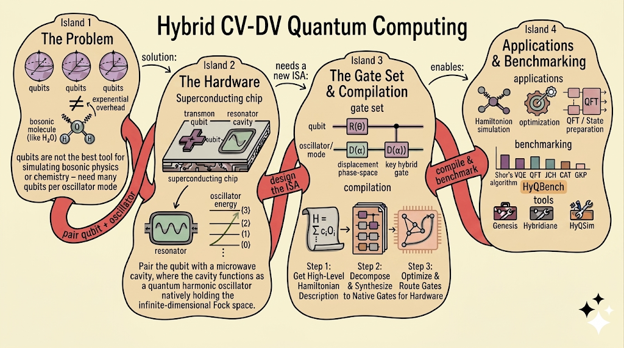
Hybrid continuous-discrete-variable (CV-DV) quantum computing combines oscillators and qubits to tackle problems that are difficult for either model alone, from bosonic simulation to quantum error correction. At ASPLOS 2026, our tutorial introduced the foundations, compilation stack, benchmarking methods, and programming tools behind this emerging architecture model. In this blog post, we overview the key elements of our tutorial.
Tutorial website: https://cvdv.ncsu.edu/resources/asplos-tutorial/
Foundations
We began with the foundations of hybrid CV-DV quantum computing, introducing the physical model, mathematical language, and programming abstractions behind qubit-oscillator systems. Many leading quantum platforms naturally combine qubits with oscillator modes, such as cavities, vibrational modes, or photonic fields. Rather than treating oscillators as auxiliary hardware, hybrid CV-DV computing views their large Hilbert spaces as a computational resource.
The tutorial covered core representations of CV states in both Fock space and phase space, along with the key operators and gate families that support universal CV-DV computation. A central message was that hybrid systems are not simply “qubits plus extra hardware,” but a distinct computational model with their own instruction sets, abstractions, and compilation challenges. We showed how familiar qubit concepts such as Pauli and Clifford structure extend into the oscillator setting through displacement operations, squeezing, quadratic Hamiltonians, beamsplitters, and controlled hybrid interactions.
We also discussed why this matters from a computer architecture perspective. Hybrid CV-DV systems introduce new instruction set architectures (ISAs), abstract machine models (AMMs), and compilation choices that help separate hardware details from software design. Depending on the platform and compiler stack, the same computation may be expressed in phase-space language, Fock-space language, or a mixed qubit-oscillator representation.
To ground these ideas, we highlighted emerging algorithmic primitives and applications where hybrid systems may offer advantages, including oscillator-mediated entangling gates, state-transfer protocols, Hamiltonian simulation, bosonic quantum error correction, vibronic dynamics, and sensing. We closed the session by surveying two leading implementation pathways, superconducting circuit QED and trapped-ion systems, and discussing the distinct control and connectivity tradeoffs they expose. A comprehensive tutorial on the foundations of hybrid CV-DV quantum processors is available here.
Compilation
We also presented Strategies and Tools to Compile CV-DV Quantum Circuits. We began by emphasizing why Hamiltonian simulation is a central application and one of the most promising directions for hybrid continuous-variable and discrete-variable (CV-DV) quantum systems. CV systems can naturally represent continuous degrees of freedom, while DV systems provide strong control and interaction structures. Together, they enable important applications in areas such as quantum chemistry and materials science. However, a key challenge lies in decomposing the time-evolution operator e^{-iHt} into a sequence of executable quantum gates. This transformation is fundamentally a compilation problem, bridging high-level quantum algorithms and low-level hardware. As such, compilers play a critical role in hybrid quantum systems.
We then focused on the dominant approach today: symbolic compilation. In particular, we discussed two early CV-DV Hamiltonian simulation compilers from Chen et al., ISCA’25 and Decker et al., QCE’25. The core idea is to avoid direct matrix-based computation and instead leverage the algebraic structure of operators for rule-based decomposition. Techniques such as Trotter-Suzuki product formulas, the Baker–Campbell–Hausdorff (BCH) expansion, and bosonic commutation relations are used to gradually break down complex Hamiltonians into hardware-executable primitive gates. This process is typically implemented through rule matching and recursive rewriting, where expressions are repeatedly transformed until only supported base gates remain. While this approach avoids the exponential blowup of high-dimensional matrices, it introduces tradeoffs between approximation error and resource overhead.
Finally, we analyzed the limitations of current compilers and outlined future research directions. Key challenges include limited gate sets and decomposition rules, the tradeoff between accuracy and resource cost, hardware connectivity constraints, and insufficient optimization flexibility. To address these issues, we highlighted the need for improved programmability, richer native gate support, more accurate cost models, and optimizations that exploit algebraic properties such as commutativity. We also presented the Genesis compiler from Chen et al., ISCA’25 as an end-to-end solution example, including typical use cases and code snippets. Genesis employs a multi-level intermediate representation (IR) and a full compilation pipeline to automatically translate Hamiltonians into limited hardware connectivity physical circuits, demonstrating a systematic and extensible compilation framework for hybrid CV-DV quantum computing.
Benchmark and Circuit Simulator
We also presented HyQBench by Mohapatra et al., an open-source benchmark suite implemented in Bosonic Qiskit and QuTiP. HyQBench covers eight representative hybrid circuits spanning three abstraction levels: primitives, algorithms, and applications. These include cat state generation, GKP state preparation, CV-to-DV state transfer, CV-DV QFT, CV-DV VQE, CV-QAOA, Jaynes-Cummings-Hubbard (JCH) Hamiltonian simulation, and Shor’s algorithm.
One key takeaway is that hybrid architectures can reduce hardware resources dramatically for some workloads. For example, simulating a 3-site JCH model in a DV-only encoding requires 9 qubits and 393 CNOT gates, whereas a hybrid implementation uses only 3 qumodes, 3 qubits, and 8 gates. This kind of reduction highlights why benchmarking hybrid systems requires more than simply counting qubits.
To support this, we introduced a feature map tailored to hybrid systems. In addition to standard structural metrics such as gate counts, circuit depth, and qubit/qumode counts, we proposed three CV-DV-specific metrics: Wigner negativity as a proxy for non-classicality and classical simulation hardness, truncation cost to quantify population near the Fock cutoff, and maximum energy. These metrics help separate workloads with very different simulation and execution behavior. For example, JCH simulation remains relatively close to Gaussian behavior, while CV-QAOA and Shor’s algorithm exhibit higher Wigner negativity and are harder to simulate classically.
We also discussed early hardware validation. A cat-state preparation benchmark was executed on Sandia National Laboratories’ QSCOUT trapped-ion platform and achieved a fidelity of 0.71. HyQBench was further used to calibrate conditional displacement gates on the same platform, reinforcing the need for standardized benchmark suites that support both evaluation and device calibration. The full paper is available at https://arxiv.org/abs/2603.04398.
To lower the barrier to entry for this area, we also developed HyQSim, a browser-based hybrid CV-DV circuit simulator that requires no installation. HyQSim supports drag-and-drop circuit construction, arbitrary Fock cutoffs, and built-in visualization through Wigner plots, Fock-state amplitudes, and Bloch sphere views. It is available at https://cvdv.ncsu.edu/resources/simulator/, and the code is hosted at https://github.com/shubdeepmohapatra01/HyQSim/.
Programming
Finally, we discussed programming support for hybrid CV-DV systems. Quantum programming languages and frameworks have developed many important ideas over the years, including linear quantum types for enforcing the no-cloning theorem, automatic uncomputation of ancilla qubits, and dynamic lifting of classical variables for mid-circuit measurement. Hybrid quantum computing introduces an additional requirement: heterogeneous quantum registers containing both qubits and qumodes.
To address this challenge, we developed Hybridlane, a CV-DV quantum programming framework built on PennyLane. By extending PennyLane, Hybridlane inherits a broad library of qubit algorithms, gates, and compilation routines while remaining familiar to existing users. Hybridlane tracks wire types automatically through symbolic circuit analysis and type inference, enabling scalable circuit construction, platform independence, and integration with downstream compilation flows.
The tutorial concluded with example workflows using Hybridlane. In one example, we reused an existing PennyLane quantum phase estimation template for a CV-DV Hamiltonian simulation and then lowered it through symbolic compilation to a gate sequence executable on the Bosonic Qiskit backend. In another, we demonstrated a cross-platform workflow in which a conditional displacement gate was calibrated in simulation and then compiled for execution on Sandia’s QSCOUT trapped-ion platform. Together, these examples showed how hybrid quantum software can begin to support the same define-simulate-execute workflow that has become standard in mature qubit SDKs.
We hope Hybridlane helps enable a broader ecosystem of reusable software and research for hybrid quantum computing. It is available at https://github.com/pnnl/hybridlane.
Closing
Hybrid CV-DV computing sits at the intersection of quantum hardware, computer architecture, compilation, and programming systems. We hope this tutorial helps make the area more accessible to researchers across architecture, systems, programming languages, and quantum information, and we invite readers to explore the tutorial materials, benchmarks, and tools linked above.
About the Authors
Yuan Liu is an Assistant Professor of Electrical & Computer Engineering and Computer Science at North Carolina State University. Prior to joining the NC State faculty, he was a postdoctoral researcher at the Massachusetts Institute of Technology. His research interests lie at the intersection of quantum computing, quantum engineering, quantum algorithms/architectures and applications.
Zihan Chen is a Ph.D. student in computer systems at Rutgers University, advised by Prof. Eddy Z. Zhang. His research focuses on compiler and system-level techniques, as well as parallel computing, to enhance the efficiency, programmability, scalability, and fault tolerance of emerging quantum computing systems.
Shubdeep Mohapatra is a Ph.D. candidate in Computer Engineering at NC State University, advised by Prof. Huiyang Zhou and Prof. Yuan Liu. His research focuses on quantum error characterization, mitigation, and benchmarking, aimed at improving the reliability and fault tolerance of near-term quantum computing systems.
Jim Furches is a post-masters research associate at Pacific Northwest National Laboratory. His current research interests are in quantum benchmarking, algorithms, and quantum programming and compilation.
Zheng (Eddy) Zhang is a Professor in the Department of Computer Science at Rutgers University. Her research focuses on full-stack compiler and programming systems for quantum computing. She studies how to better coordinate quantum applications, programming languages, intermediate representations, compilation, pulse-level control, and hardware architecture to improve the performance, usability, and scalability of quantum systems.
Huiyang Zhou is a Professor of Electrical and Computer Engineering at North Carolina State University. His current research interests include GPU architecture, processor security, and quantum computing.
Disclaimer: These posts are written by individual contributors to share their thoughts on the Computer Architecture Today blog for the benefit of the community. Any views or opinions represented in this blog are personal, belong solely to the blog author and do not represent those of ACM SIGARCH or its parent organization, ACM.