
by Karu Sankaralingam on Apr 10, 2026 | Tags: Architecture, Evaluation, Machine Learning
For decades, we have designed chips in fundamentally the same way: human intuition applied to a vanishingly small slice of an impossibly large design space. That paradigm worked when Moore’s Law was lifting everything. We could afford to be wrong. We could...
Read more...

by Adnan Rakin on Apr 6, 2026 | Tags: deep neural networks, Security, side-channels
Years ago, I came across three pioneering works (CSI-NN, Cache Telepathy, and DeepSniffer) in the field of reverse engineering neural networks that inspired my journey into side-channel attacks to uncover the secrets of modern Deep Neural Networks (DNNs). Fast forward...
Read more...
by Sai Srivatsa Bhamidipati on Mar 12, 2026 | Tags: Accelerators, deep neural networks, Machine Learning
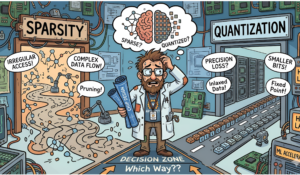
The debate of sparsity versus quantization has made its rounds in the ML optimization community for many years. Now, with the Generative AI revolution, the debate is intensifying. While these might both seem like simple mathematical approximations to an AI researcher,...
Read more...

by Dmitry Ponomarev on Feb 3, 2026 | Tags: Blog, Editorial
As we close the book on 2025, Computer Architecture Today has seen another successful year of community engagement. We published 29 posts covering a wide spectrum of topics—from datacenter energy-efficiency to the evolving debate on LLMs in peer review, alongside trip...
Read more...

by Zhongming Yu and Jishen Zhao on Jan 20, 2026 | Tags: Agents, LLM, Memory Consistency, Memory Hierarchy
Large language model (LLM) agents are quickly moving from “single agent” to *multi-agent systems*: tool-using agents, planner-orchestrator, debate teams, specialized sub-agents that collaborate to solve tasks. At the same time, the *context* these agents must operate...
Read more...

by Mark D. Hill on Jan 12, 2026 | Tags: Accelerators, Memory, Modelling
TL;DR: Latency-tolerant architectures, e.g., GPUs, increasingly use memory/storage hierarchies, e.g., for KV Caches to speed Large-Language Model AI inference. To aid codesign of such workloads and architectures, we develop the simple PipeOrgan analytic model for...
Read more...