
The conference
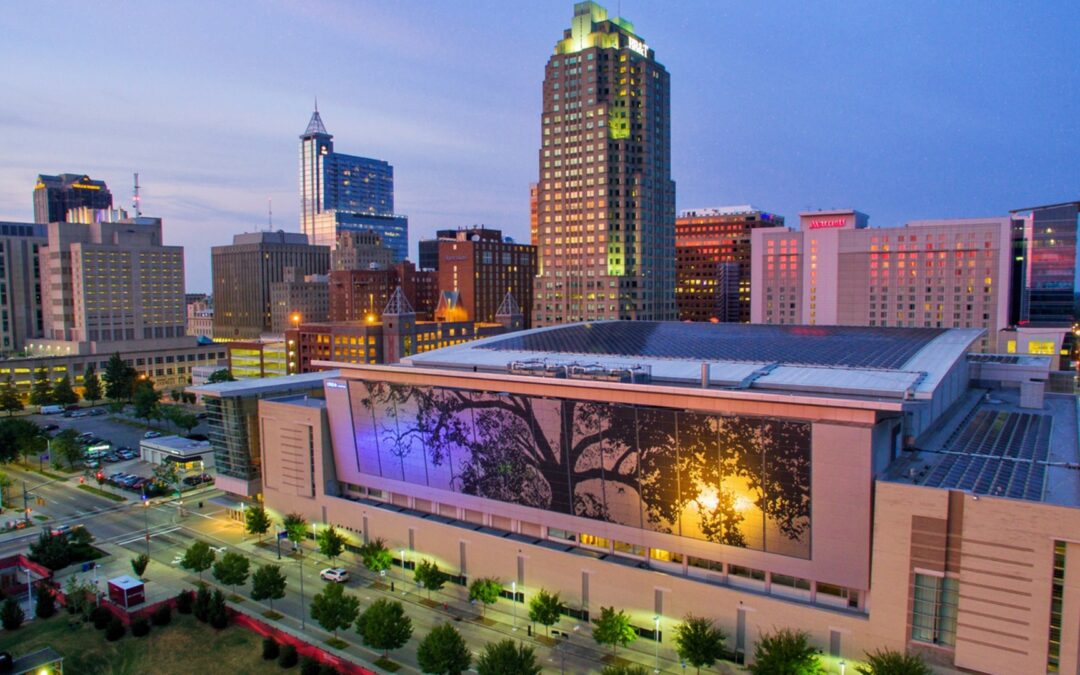
The 53rd International Symposium on Computer Architecture (ISCA) was held at the Raleigh Convention Center in Raleigh, North Carolina, from June 27 to July 1, 2026. Raleigh sits at one corner of the Research Triangle, anchored by North Carolina State University, the University of North Carolina at Chapel Hill, and Duke University. General Chairs Huiyang Zhou and James Tuck, both of NC State, led the organizing effort.
The most notable structural change this year was that ISCA offered remote attendance, making it a hybrid conference. The organizers provided deeply discounted remote registration to broaden access for students and researchers who could not travel, broadcast the main and keynote sessions on Zoom, and made recordings available to registrants for offline viewing. This was ISCA’s first hybrid offering and an experiment intended to lay groundwork for remote attendance at future architecture conferences.
Workshops and tutorials
Preceding the main symposium, ISCA 2026 opened with two full days of workshops and tutorials on Saturday, June 27 and Sunday, June 28, organized by Workshops and Tutorials Co-Chairs Lisa Wu Wills (Duke) and Brandon Reagen (NYU). The program totaled 15 workshops and 16 tutorials, spanning the full breadth of the field, from open-source infrastructure and DRAM to quantum computing, encrypted AI, and agentic design.
Saturday’s tutorials leaned on open-source and simulation infrastructure, such as ASTRA-sim, the Ramulator and DRAM Bender memory tools, and FAVA on formal hardware verification, while the workshops included gem5, SAFE AI on encrypted AI, and Architecture 2.0 on agentic AI for computing-systems design, which marked the launch of the book Architecture 2.0: Agentic Design Loops for Computing System Synthesis. Sunday leaned into mentoring, open-source hardware, and quantum: the uArch Mentoring Workshop and YArch’26 for students; XiangShan and the SODA Synthesizer on the open-source side; and FHE & Cheddar and Janus 4.0 for quantum, alongside the 6th DRAMSec, a carbon-accounting tutorial, and the Championship in Branch Prediction.
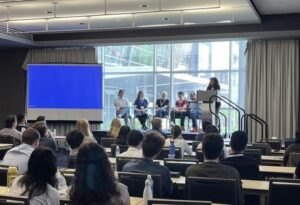
Panel on the Impact of AI on Higher Education & Computer Architecture @uArch 2026
The main program
This was the largest ISCA program ever. Program Co-Chair Carole-Jean Wu (FAIR, Meta) and Kevin Skadron (University of Virginia) reported 850 regular-track submissions, a 49% increase over the previous year, of which 161 were accepted, for an 18.9% acceptance rate (down from 23% the year before). To accommodate the volume, ISCA ran a fourth parallel track for the first time.
The reviewing operation scaled to match. It involved 22 Area Chairs, 211 full PC members, and 192 lightweight PC members, by far the largest committee in the conference’s history. Reviewing ran in two rounds, with most papers reaching six reviews. Discussion followed the “Identify the Champion” model; 301 papers reached a clear online consensus, while the remaining 59 were resolved in a series of real-time Zoom PC meetings held over five days. In the end, 116 papers were accepted outright and another 45 were conditionally accepted with shepherding, all of which were eventually accepted.
Keynotes
ISCA 2026 featured three keynotes.
Debbie Marr (CEO and Co-Founder of AheadComputing) opened with “Computing at the Crossroads: Architecture, Economics, and the Next Era.” She reflected on the trajectories that shaped the field: Moore’s Law, Dennard scaling, increasing abstraction, and the long expansion of general-purpose computing. Many of those assumptions, she observed, are now being questioned simultaneously. She tied the technical inflection point to shifting economics, ecosystem dynamics, and leadership transitions, and suggested that the architecture community’s choices today will define the next era of computing.
The second keynote piloted a new “dialogue” format on quantum computing, pairing Fred Chong (University of Chicago; Chief Scientist for Quantum Software at Infleqtion) and Jay Gambetta (IBM Fellow and Director of Research) for “Architecting Hybrid Quantum-Classical Computing for Scale and Fault Tolerance.” Their shared theme: with fault-tolerant machines on the horizon and near-term machines increasingly integrated with classical HPC, computing will be heterogeneous and accelerator-based, and architects are needed to bridge theory and physical technology across applications, software, error correction, workflow management, and machine organization.
Babak Falsafi (EPFL) closed the keynote lineup with “Beyond the AI Energy Wall: Optimal Server Design and Operation”. He described how AI is pushing cloud infrastructure toward an energy wall, with compute demand growing faster than power, cooling, and datacenter capacity can be sustainably provisioned, and suggested that clearing it requires full-stack optimization rather than simply scaling accelerators or building larger facilities. He questioned the long-standing assumption that single-thread performance should dominate server design and operation.
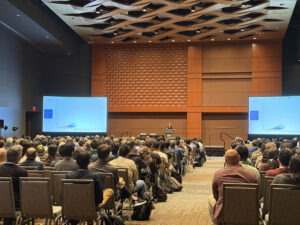
Keynote by Debbie Marr (Computing at the Crossroads)
Awards
A number of the community’s honors were presented during the conference.
The ACM/IEEE-CS Eckert-Mauchly Award went to Srinivas Devadas (MIT) for pioneering contributions to secure architectures with broad industrial and academic impact. The ACM SIGARCH Maurice Wilkes Award was presented to Tushar Krishna (Georgia Tech) for outstanding contributions to architectures and modeling tools for large-scale AI systems. The TCCA Young Architect Award went to Akshitha Sriraman (Carnegie Mellon University) for contributions to the design and management of efficient and sustainable cloud datacenters. The ACM SIGARCH/IEEE CS TCCA Outstanding Dissertation Award went to Olivia Hsu (Stanford University), with an honorable mention to Jovan Stojkovic (University of Illinois Urbana-Champaign). The SIGARCH Alan D. Berenbaum Distinguished Service Award was presented to Sarita Adve (University of Illinois Urbana-Champaign) for sustained and transformative contributions to ACM SIGARCH, the broader architecture community, and via CARES, the ACM SIG ecosystem. The ISCA Influential Paper Award recognized “Adaptive Insertion Policies for High Performance Caching” (ISCA 2007) by Moinuddin K. Qureshi, Aamer Jaleel, Yale N. Patt, Simon C. Steely, and Joel Emer, for its commercial impact and for reinvigorating research on cache management with an elegant set-dueling framework that can be broadly applied to cache-policy selection.
Two ISCA Best Paper Awards were selected from a field of five nominations: “Cerberus: Cross-Layer ECC Co-Design for Robust and Efficient Memory Protection” — Junhwan Kim, Seunghyun Kim, Yesin Ryu, Saeid Gorgin, and Jungrae Kim. “Patterns Behind Chaos: Forecasting Data Movement for Efficient Large-Scale MoE LLM Inference” — Zhongkai Yu, Yue Guan, Zihao Yu, Chenyang Zhou, Zhengding Hu, Shuyi Pei, Yangwook Kang, Yufei Ding, and Po-An Tsai.
Two ISCA Distinguished Artifact Awards were also recognized: “Transpiler-Architecture Co-Design to Curb Clifford Costs in Fault-Tolerant Quantum Computing” — Meng Wang, Chenxu Liu, Samuel Stein, Yufei Ding, Poulami Das, Prashant Nair, and Ang Li. “Towards Practical Interrupt Side-Channel Attacks on macOS for Apple Silicon” — Xin Zhang, Chang Liu, Jiajun Zou, Yi Yang, Qingni Shen, Zhi Zhang, and Trevor E. Carlson.
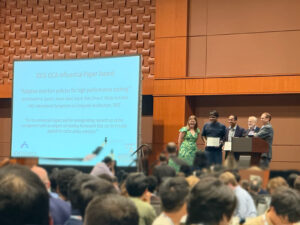
ISCA Influential Paper Award recipients
Industry track and artifact evaluation
The Industry Track, chaired by Brad Beckmann (AMD), accepted 11 papers out of 27, reviewed by a 32-member committee drawn entirely from industry across a diverse set of startups and established companies. The accepted set ranged from silicon to software. Two additional papers were recommended for an IEEE Micro Special Issue on Commercial Products.
Artifact Evaluation, in its fourth year at ISCA, received 49 submissions. 42 papers earned all three badges (Available, Functional, and Reproduced), 3 earned Available and Functional, and 4 earned Available. The co-chairs Hyeran Jeon (UC Merced), Linghao Song (Yale), and Mark Zhao (University of Colorado Boulder) flagged a growing challenge: the increasing heterogeneity of hardware and software platforms, which reviewers do not always have access to.
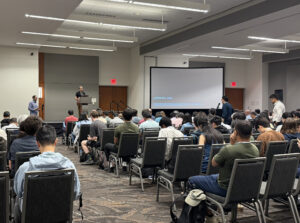
A snapshot of the Industry Track session
Excursion
ISCA’s excursion was an evening dinner and social at Raleigh’s historic City Market. Built in 1914 and known for its cobblestone streets and early-twentieth-century lamplight, the district hosted a relaxed, open-air affair, with food stations of North Carolina–inspired dishes, beer, and wine spread across the historic Market Hall, The Grove, and the outdoor spaces between them. With attendees spilling across the market, it made for an excellent networking opportunity and a welcome chance to unwind and catch up with people after the intensity of the technical program.

Excursion venue: City Market
About the author: Bingyao Li is an Assistant Professor in the Computer Science and Engineering Department at the University of California, Riverside. Her research focuses on designing architecture and system features for next-generation GPU platforms and building high-performance LLM infrastructure and systems.
Disclaimer: These posts are written by individual contributors to share their thoughts on the Computer Architecture Today blog for the benefit of the community. Any views or opinions represented in this blog are personal, belong solely to the blog author and do not represent those of ACM SIGARCH or its parent organization, ACM.